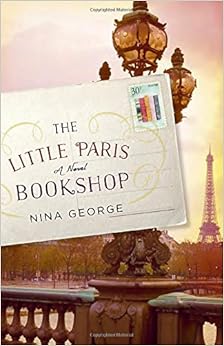
 After seeing this on the PNW bestseller list for weeks on end, and considering I was heading to Paris, I figured it was time to read this little gem...and it is a beauty. Beautifully written, it encompasses the life of Monsieur Perdu, a bookseller whose barge on the Seine river in Paris provides a world of words, imagination, and beauty for so many customers and neighbors. However, Perdu is haunted by the loss of his own years ago and has yet to rejoin the human race. As he takes a 'walkabout' down the river, meeting all sorts of humans, he recommends books to heal, books to inspire, and books to teach - whatever he 'sees' the person needs at that moment. This novel is about not only finding love and forgiveness in one's life, but also about the comfort and solace so many of us find in books. Read in the long plane ride to Paris, this is truly a lovely read.
Wonder by R.J. Palacio
 This is a spectacular YA book, that should be read by adults, as well as kids, most especially for all my teacher friends. The story tells of a young boy named Auggie whose life took a big u-turn at birth, as he was born with a double-genetic malnormality, creating a face that scares parents and children alike, and leaves Auggue wanting to permanently wear the Star Wars space helmet he got as a little boy. Now an eleven year old middle-schooler, after 37 painful operations, it is time for Auggie to brave the world of school. Your heart will break as you read not only of the overt teasing and cries of horror by other students, but the more painful, insidious bullying of a bright, courageous, funny, and thoroughly delightful young man as he teaches all of us what it means to be a 'wonder' in today's world.
Missoula: Rape and the Justice System in a College Town by Jon Krakauer
 If you are from the PNW, you would be hard-pressed to not know of Jon Krakauer, the Outside magazine writer who has exposed us to so many incredible tales over the years: Into the Wild, Into Thin Air, Under the Banner of Heaven, and Where Men Win Glory. Within his non-fiction books, Krakauer always does a thorough job of reporting, gathering information not only from the main subjects, but from the vital peripheral ones as well. He does not disappoint with his latest book, but he will leave you disturbed, angry, and saddened over the climate of sexual abuse, discrimination, and blatant miscarriage of justice not only in universities today, but in American society. Krakauer looks at a few specific cases in Missoula, following cases that are not prosecuted, ones that are settled, and even a case that goes all the way to trial. At the end of this book, you will not feel satisfied and delighted; however, I do believe this is absolutely a book that everyone should read - parents with both sons and daughters, folks sending kids to college, anyone involved with young men and women today, particularly in an educational setting. You will never view the crime of rape in the same way again.
I'll Give You the Sun by Jandy Nelson
 This is the book that pretty much every staffer at Village Books, our delightful independent bookseller here in Bellingham, has on their 'staff pick' book shelf. Technically classified as YA, I would say this is merely because the main characters are teens; nothing else is 'young' in this novel. As the book opens, we are immediately introduced to twins Noah and Jude, and throughout the book we see the story unfold through their eyes, as the author slides us back and forth in time. All we know is that these two siblings who used to stand shoulder to shoulder as they did in the womb, have split somehow from each other. We see Noah, an artistically brilliant young 'Picasso-esque' teen, attempting to cope with society when he does not really fit in. Jude, a brash, independent young woman morphs into a creature who hides from society. Jandy Nelson, a brilliant writer, keeps the reader obsessively turning pages, putting together the pieces of all the characters, not just the twins but the artistic mother, the math-professor father, the tortured sculptor, and the homeless drug-addicted teenager who inhabit the twins' lives. In the end, I agree with the VB staff - this is the most brilliantly written, magical, heart-wrenching, and redemptive book I have read in 2015. I cannot recommend it highly enough.
When the Moon is Low by Nadia Hashimi
 The author of one of my 2014 favorites, The Pearl that Broke its Shell, has come out with book number two and it does not disappoint. Once again, Hashimi returns to Afghanistan but this time in today's world. The story begins as a rather typical tale of Fereiba, a middle-class Afghani woman who wants more than her role as a wife and a mother. Married to a wonderful man, educated, raising a family, life is good in Kabul...until of course, the Russians and the Taliban. However, this is not the story of their fight against these forces. Instead, the author uses the BBC headlines of today and tells a tale of Fereiba and her teenage son, Saleem, as they become the undocumented refugees we read about each day, trying desperately to get to safety in a northern European country. As I read this book, I saw real-life stories on the immigrants trying to sneak through the tunnel at Calais in an attempt to get to England, of the huge migration issues in Greece and Macedonia, and I saw the attempts by 'good' countries as they shut their borders to the people who need them most. Ferieba and Saleem are good people who were dealt a rotten hand on where they were from - I will never look at the immigration issue the same way again. This would be a fantastic book club book as it brings up topical, political, familial, and cultural issues that so many of us see from varied viewpoints.
Seveneves by Neal Stephenson
 "The moon blew up without warning and for no apparent reason." Yep, that is the first line of this wildly popular, best-selling science fiction book from acclaimed writer Neal Stephenson. The obvious premise from the beginning is the complex issues that involve the world when the moon is broken into seven large pieces by an unknown Agent. It quickly morphs into a tale of an epic odyssey...how humanity survives as the fallout of the rocks create a 'rain' that covers the earth in fire for five thousand years. Yes, you heard right - 5,000 years. While I have always loved post-apocalyptic tales, they usually entail disease and war, creating a 'life is over as we know it' type of story line. This was a whole new venture for me, as I can count on one hand the sci-fi books I have read in the past. Neal Stephenson is a great author to begin with in the science fiction genre, as the man creates incredibly complex and intriguing characters, is purposeful in each step of his plot construction, and builds tension so that it is hard to close the book at night. I obsessively read this 850 page book, dreaming at night of the end of the world and constantly wondering what the next step in survival would be. Due to his vast knowledge of physics and engineering, Stephenson occasionally lost me in his complicated details and I admittedly skimmed those paragraphs after figuring out I could never understand the concepts anyway. And no, I do not feel guilty - I didn't miss anything of the plot and I didn't give up on the book. For my first foray into space, I am thoroughly satisfied. Destined to be a classic, I highly recommend Seveneves.